ABC is everywhere
Athletes, Box Owners and Coaches. Analyze, Benchmark and Calibrate. Average, Balance and Consistency. Apex, Bold and Core. ABC isn't just the name — it's how the product is structured.
Who it connects
Athletes
People who train, log results, and track their progress.
How it works
Analyze
Collect and understand relevant athlete performance data.
What it measures
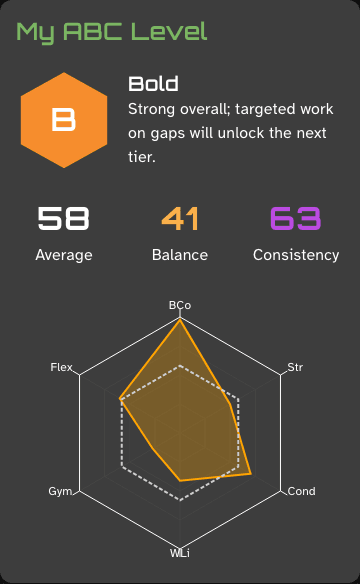
Average
Overall performance across the six evaluated domains.
How levels are expressed
Apex
The top tier of the ABC Level scale.
Who it connects
Box Owners
People responsible for the community and programming.
How it works
Benchmark
Compare results against the ABC Level model and standards.
What it measures
Balance
How evenly performance is spread across domains.
How levels are expressed
Bold
A strong, above-average tier of the ABC Level scale.
Who it connects
Coaches
People who use athlete data to coach and program better.
How it works
Calibrate
Turn results into decisions on progression and scaling.
What it measures
Consistency
How regularly an athlete trains against their own target.
How levels are expressed
Core
A developing, foundational tier of the ABC Level scale.
The real product
What your grade means
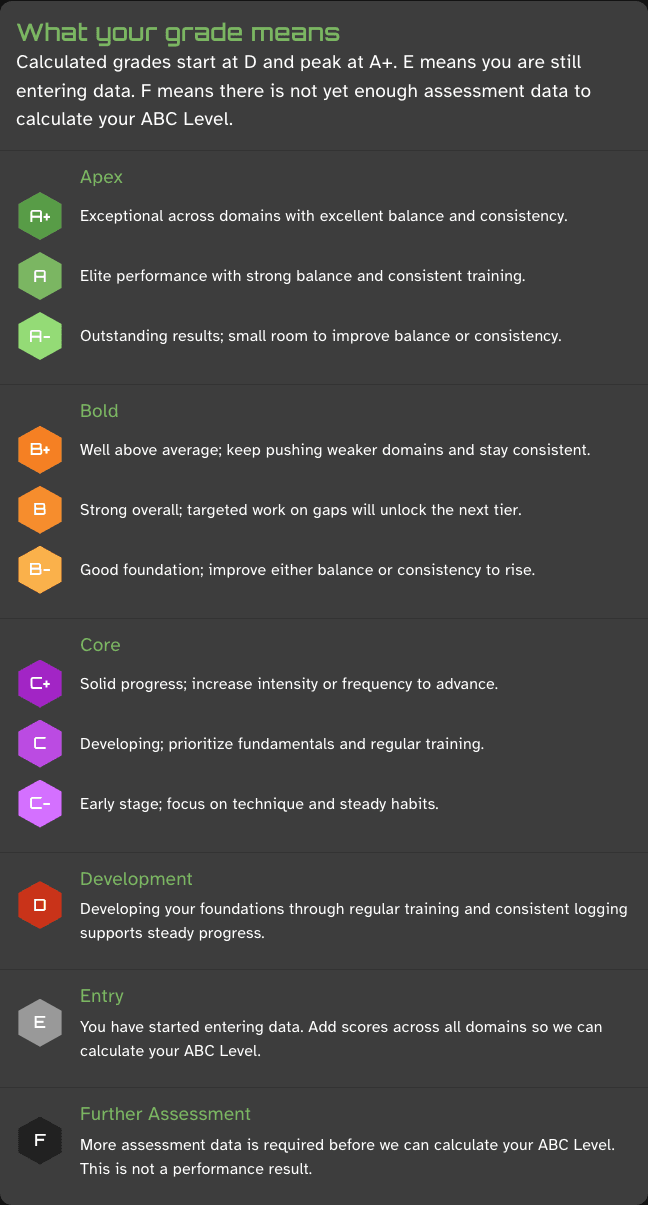
Calculated grades start at D and peak at A+. E means you are still entering data. F means there is not yet enough assessment data to calculate your ABC Level.
Apex
Exceptional across domains with excellent balance and consistency.
Elite performance with strong balance and consistent training.
Outstanding results; small room to improve balance or consistency.
Bold
Well above average; keep pushing weaker domains and stay consistent.
Strong overall; targeted work on gaps will unlock the next tier.
Good foundation; improve either balance or consistency to rise.
Core
Solid progress; increase intensity or frequency to advance.
Developing; prioritize fundamentals and regular training.
Early stage; focus on technique and steady habits.
Development
Developing your foundations through regular training and consistent logging supports steady progress.
Entry
You have started entering data. Add scores across all domains so we can calculate your ABC Level.
Further Assessment
More assessment data is required before we can calculate your ABC Level. This is not a performance result.
Six domains, one complete picture
ABC Level is a broader view of the athlete, not a score based on one workout or one lift.
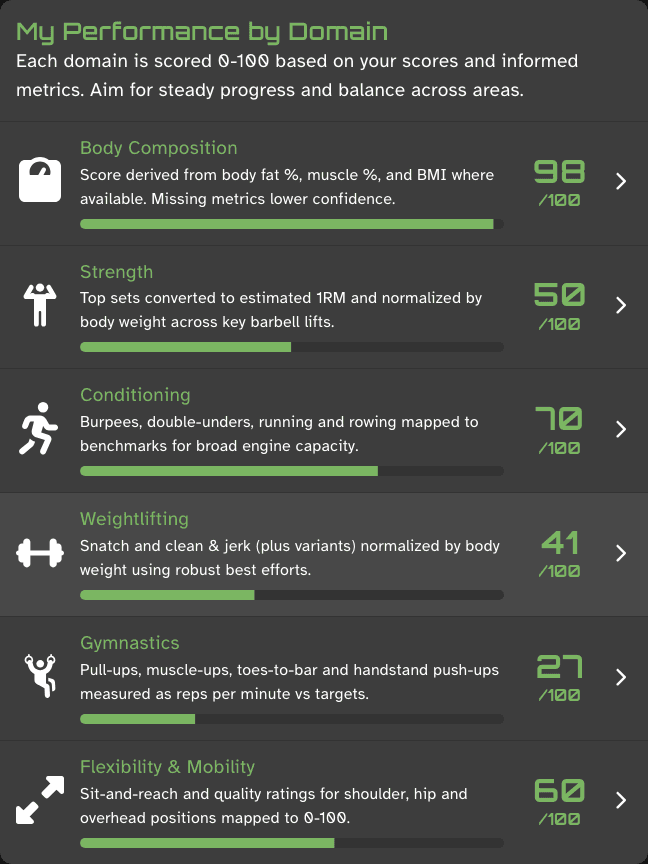
Body Composition
Score derived from body fat %, muscle %, and BMI where available. Missing metrics lower confidence.
Strength
Top sets converted to estimated 1RM and normalized by body weight across key barbell lifts.
Conditioning
Burpees, double-unders, running and rowing mapped to benchmarks for broad engine capacity.
Weightlifting
Snatch and clean & jerk (plus variants) normalized by body weight using robust best efforts.
Gymnastics
Pull-ups, muscle-ups, toes-to-bar and handstand push-ups measured as reps per minute vs targets.
Flexibility & Mobility
Sit-and-reach and quality ratings for shoulder, hip and overhead positions mapped to 0-100.
Average, Balance, Consistency
Your ABC Level blends three real signals from your training, not just your best lift.
Average
Your overall performance across the six evaluated domains.
Balance
How evenly your performance is spread across domains — rewards being well-rounded and encourages filling gaps rather than skipping domains.
Consistency
How regularly you train against your own weekly training target — rewards steady, regular training, not total volume.
Why ABC Level matters
For the Athlete
Know yourself.
See where you stand across strength, weightlifting, gymnastics, conditioning, flexibility and body composition — and which one needs your attention next. Train with better awareness, not guesswork.
For the Coach
Know the athlete.
See strengths, weaknesses, balance and consistency for every athlete you coach — not just their last workout — so scaling decisions and personal training sessions start from real information.
For the Box Owner
Know your community.
Review your athletes' ABC Levels side by side to spot patterns across the box, and use what you see to inform future programming.